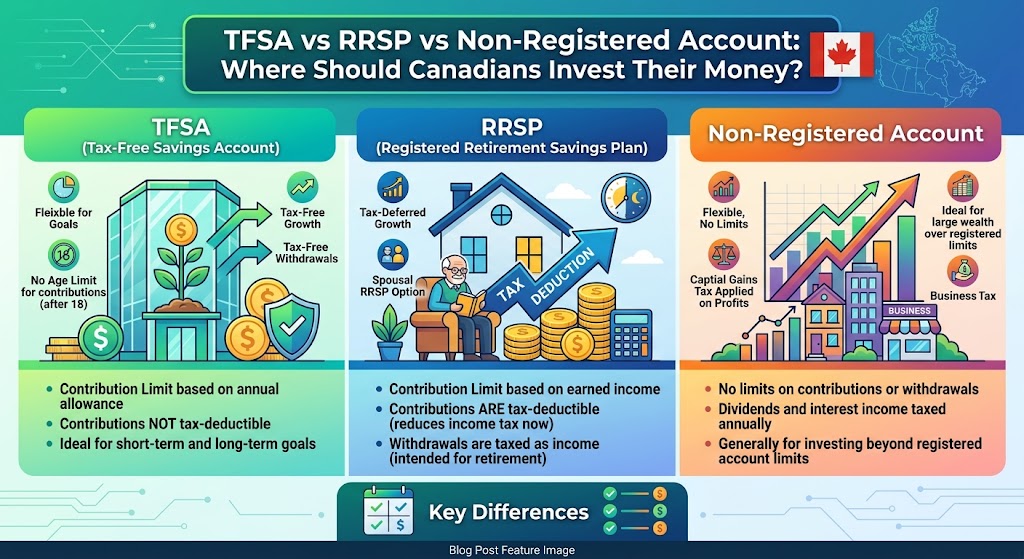
TFSA vs RRSP vs Non-Registered Account: Where Should Canadians Invest Their Money?
October 8, 2026If you have money to invest in Canada, one of the most important decisions is not which stock or ETF to buy.
It is which account you should buy it in.
Canadian investors have several choices, but three accounts come up again and again:
- TFSA — Tax-Free Savings Account
- RRSP — Registered Retirement Savings Plan
- Non-registered investment account
Each has different tax rules, contribution limits, withdrawal rules, and advantages.
So which one is best?
The short answer is:
There is no single best account for every Canadian.
For many people, the best strategy is to use a combination of accounts based on their income, goals, time horizon, and available contribution room.
This guide explains the differences and provides a practical framework for deciding where to invest your money in 2026.
TFSA vs RRSP vs Non-Registered: At a Glance
Before going into the details, here is the basic difference.
| Feature | TFSA | RRSP | Non-Registered |
|---|---|---|---|
| Contributions tax-deductible? | No | Generally yes | No |
| Investment growth | Generally tax-free | Tax-deferred | Taxable according to investment type |
| Withdrawals | Generally tax-free | Generally taxable | Generally not taxed as a withdrawal |
| Contribution room | Annual + unused room | Based mainly on earned income + unused room | No annual contribution limit |
| Best known for | Flexible tax-free investing | Retirement savings | Investing after registered room is used |
| Access to money | Flexible | Less flexible | Flexible |
| Tax on investment income | Generally none | Generally deferred while inside account | Generally taxable |
| 2026 annual limit | $7,000 + unused room | Based on available RRSP deduction limit | None |
The details matter, however, so let’s look at each account separately.
1. What Is a TFSA?
The Tax-Free Savings Account is one of the most useful investment accounts available to Canadian residents.
Despite the word “savings” in its name, a TFSA can be used for much more than a traditional savings account.
Depending on the type of TFSA, you can hold investments such as stocks, ETFs, mutual funds, and GICs. Investment income and gains earned inside the TFSA are generally tax-free, including when you withdraw the money.
The biggest advantage of a TFSA
The key feature is simple:
You contribute after-tax money, but qualifying investment growth and withdrawals are generally tax-free.
For example, suppose you contribute $20,000 to a TFSA and the investments eventually grow to $35,000.
The $15,000 increase is generally not taxed when you withdraw it.
That’s a powerful feature for long-term investors.
How Much Can You Contribute to a TFSA in 2026?
The 2026 TFSA dollar limit is $7,000.
However, your actual contribution room may be considerably higher because unused room can carry forward from previous years. Withdrawals also create new contribution room, but that room generally becomes available on January 1 of the following year.
This is important:
Do not assume that your available TFSA room is simply $7,000.
Check your actual contribution room through your CRA account and your own financial records before contributing.
Over-contributing can result in a tax charge.
2. What Is an RRSP?
An RRSP is designed primarily for retirement savings.
Unlike a TFSA, an RRSP can provide an immediate tax deduction for eligible contributions.
In general, the amount you can deduct is based on your available RRSP deduction limit, which is shown on your CRA information. The calculation generally incorporates unused room and a percentage of previous-year earned income, subject to the annual limit and pension adjustments.
For 2026, the RRSP dollar limit is $33,810, although your personal contribution/deduction room may be lower depending on your circumstances.
Why is the RRSP tax deduction valuable?
Suppose you earn a relatively high income and contribute $10,000 to an RRSP.
That contribution may reduce your taxable income for the year, subject to your available RRSP deduction room and applicable tax rules.
The investments can then grow inside the RRSP without being taxed as the income accrues.
However, there is an important trade-off:
RRSP withdrawals are generally taxable as income.
In other words, the RRSP generally provides tax deferral, rather than permanent tax-free treatment.
3. What Is a Non-Registered Investment Account?
A non-registered account is essentially a regular investment account that doesn’t have the special tax treatment of a TFSA or RRSP.
There is no annual contribution limit.
That makes it particularly useful once you have used your available registered-account room.
For example, suppose you have:
- $20,000 available in your TFSA
- $50,000 available in your RRSP
- $100,000 you want to invest
You could potentially use the TFSA and RRSP first, with the remaining investment money going into a non-registered account, depending on your circumstances.
The downside is taxation.
In a non-registered account, investment income can be taxable.
Depending on the investment, this may include:
- Interest income
- Dividends
- Capital gains
The CRA requires investment income such as interest, dividends, and taxable capital gains to be reported under the applicable tax rules.
4. The Most Important Difference: How Taxes Work
The easiest way to understand these accounts is to think about when the government taxes you.
TFSA
Tax before contribution → generally no tax on qualifying investment growth or withdrawal
RRSP
Potential tax deduction when contributing → tax generally deferred → withdrawal generally taxable
Non-registered account
After-tax contribution → investment income/gains may be taxable
This is why choosing the right account can have a significant impact on long-term wealth.
5. TFSA vs RRSP: Which Is Better?
This is probably the most common question Canadian investors ask.
Unfortunately, there is no universal answer.
The better choice depends heavily on your income and when you expect to use the money.
TFSA May Be More Attractive If You Want Flexibility
A TFSA can be particularly attractive when:
- You may need the money before retirement
- Your current income is relatively low
- You want tax-free withdrawals
- You are saving for a variety of financial goals
- You want to avoid having withdrawals added to taxable income
TFSA withdrawals generally don’t create taxable income.
That can make the account useful for goals that don’t fit neatly into a retirement plan.
RRSP May Be More Attractive at Higher Income Levels
An RRSP can become particularly valuable when your current marginal tax rate is relatively high and you expect your taxable income to be lower in retirement.
The basic idea is:
Get the deduction when your tax rate is relatively high, then pay tax on withdrawals when your tax rate may be lower.
This is one reason RRSPs are often particularly attractive to higher-income working Canadians.
But individual circumstances matter.
Someone with a generous workplace pension, for example, may have a very different retirement-income situation from someone without a pension.
6. A Simple Example
Imagine two Canadians each have $10,000 available to invest.
Investor A
Investor A has a relatively low taxable income.
They don’t receive a large immediate benefit from an RRSP deduction.
A TFSA may therefore be particularly attractive because future qualifying investment growth and withdrawals can generally be tax-free.
Investor B
Investor B has a relatively high taxable income.
An RRSP contribution may provide a more valuable tax deduction today.
If Investor B expects to have a lower taxable income in retirement, the RRSP may provide a useful tax-deferral advantage.
Neither investor is automatically making the “correct” choice.
The point is that the same $10,000 can have a different optimal account depending on the investor.
7. What About a Non-Registered Account?
Many Canadians assume they should avoid non-registered accounts.
That’s not necessarily true.
A non-registered account can be extremely useful.
The biggest advantage is simple:
There is no annual contribution limit.
If you have already used your available TFSA and RRSP room, a non-registered account gives you another place to invest.
It can also provide flexibility because withdrawals aren’t governed by TFSA contribution-room rules or RRSP withdrawal taxation.
The trade-off is that investment income and realized capital gains can create tax consequences.
8. Don’t Forget About the FHSA
If you are eligible to use a First Home Savings Account (FHSA) and are saving for a qualifying first home, you should generally consider it alongside the TFSA and RRSP.
The FHSA can provide a tax deduction for eligible contributions, while qualifying withdrawals for a first home can generally be made tax-free.
For someone who qualifies and has a first-home goal, the FHSA can therefore be an important part of the account-selection decision.
9. Where Should You Put Your Investments?
The account is only one part of the decision.
You also need to decide what investments to hold inside the account.
For example, you might hold:
- ETFs
- Individual stocks
- Bonds
- GICs
- Mutual funds
- Cash
The same investment can have different tax implications depending on which account holds it.
This is sometimes called asset location.
For more advanced investors, asset location can become an important part of portfolio construction.
But beginners shouldn’t let this make investing unnecessarily complicated.
First understand:
What is my goal?
How much risk can I accept?
Which account makes sense?
Then choose appropriate investments.
10. A Practical Priority Order
There is no universal rule that says every Canadian should follow exactly the same sequence.
However, a reasonable framework is:
If you’re saving for a first home
Consider whether an FHSA is available to you.
If you have high-interest debt
Consider paying down that debt before aggressively investing.
If you have an employer retirement plan
Understand how your employer contributions and pension affect your overall retirement strategy.
If you have TFSA room
Consider using your TFSA for flexible long-term investing.
If you have significant taxable income
Consider whether RRSP contributions could provide valuable tax deductions.
If you’ve used your registered-account room
Consider a non-registered investment account.
The order can change depending on your personal circumstances.
11. What If You Have $50,000 to Invest?
Let’s consider a hypothetical example.
Suppose someone has $50,000 sitting in cash and wants to invest it for the long term.
They shouldn’t automatically put the entire amount into one account.
Instead, they might first determine:
- How much emergency savings they need
- Whether they have high-interest debt
- Their TFSA contribution room
- Their RRSP deduction room
- Whether they qualify for an FHSA
- Their current income
- Their expected retirement income
- When they expect to need the money
Only then does it make sense to decide how much goes into each account.
For example, if the person has substantial unused TFSA room and a high current income, their situation could lead to a very different strategy from someone with low income and no retirement savings.
12. What If You Have $100,000 to Invest?
The same principle applies.
Having more money doesn’t make the decision simpler.
It makes tax planning more important.
A $100,000 portfolio could potentially be spread across several account types.
For example:
TFSA
For tax-free long-term growth and flexibility.
RRSP
For retirement savings and potential tax deductions.
Non-registered account
For additional investing beyond available registered-account room.
The actual allocation should depend on the investor’s financial circumstances rather than an arbitrary percentage.
13. Common Mistakes Canadians Make
Mistake #1: Treating a TFSA Like a Regular Savings Account
A TFSA can hold investments.
Calling it a “savings account” can cause beginners to underestimate its potential as a long-term investment vehicle.
Mistake #2: Assuming RRSPs Are Always Better
RRSPs are powerful, but they are not automatically superior to TFSAs.
The tax deduction is valuable, but withdrawals are generally taxable.
The right choice depends on your current and future tax situation.
Mistake #3: Ignoring TFSA Contribution Room
Don’t simply assume you have $7,000 of room in 2026.
You may have unused room from previous years.
Conversely, you may have less room than you expect if you have already made contributions.
Always verify your actual room.
Mistake #4: Thinking Withdrawals Restore Room Immediately
TFSA withdrawals do not normally create new contribution room immediately.
The withdrawn amount is generally added back on January 1 of the following calendar year.
This is an easy rule to overlook.
Mistake #5: Putting Everything in a Non-Registered Account
If you have significant unused TFSA or RRSP room, investing everything in a taxable account may create unnecessary tax consequences.
Look at your registered-account options first.
Mistake #6: Choosing Investments Before Choosing the Account
Many beginners start by asking:
“Which ETF should I buy?”
A better sequence is:
“What am I investing for?”
Then:
“Which account should I use?”
Then:
“What investment fits my plan?”
14. TFSA vs RRSP vs Non-Registered: Which One Should You Choose?
Here is a simplified guide.
Choose TFSA when:
- You want flexibility
- You want qualifying investment growth and withdrawals to be generally tax-free
- You have available contribution room
- You may need the money before retirement
- Your current income isn’t high enough for an RRSP deduction to be especially valuable
Consider RRSP when:
- You have earned income and available RRSP deduction room
- Your current marginal tax rate is relatively high
- You’re investing primarily for retirement
- You expect your taxable income to be lower in retirement
- The tax deduction is valuable to you
Consider a non-registered account when:
- You’ve used your available registered-account room
- You want to invest more than your TFSA/RRSP limits allow
- You want additional flexibility
- You’re comfortable managing the tax reporting associated with taxable investments
Consider an FHSA when:
- You’re eligible
- You’re saving for a qualifying first home
- You have available FHSA contribution room
15. The Best Strategy May Be to Use All Three
One of the biggest misconceptions is that Canadians need to choose exactly one account.
You don’t.
A long-term investor might eventually have:
TFSA + RRSP + non-registered account
all at the same time.
For example:
TFSA: Flexible, tax-free long-term investments
RRSP: Retirement-focused investments and tax deferral
Non-registered: Additional investments after registered room is used
This can provide a combination of tax efficiency and flexibility.
16. A Simple Decision Tree
If you are unsure where to invest your next dollar, start with these questions.
Question 1: Do I have high-interest debt?
If yes, consider addressing that before aggressively investing.
Question 2: Am I saving for a first home?
If yes, check whether an FHSA is available to you.
Question 3: Do I have TFSA room?
If yes, consider whether a TFSA fits your goal.
Question 4: Do I have RRSP room?
If yes, consider whether the tax deduction is valuable given your current income.
Question 5: Have I used my registered-account room?
If yes, a non-registered account may be appropriate for additional investments.
The Bottom Line
The question isn’t really:
“TFSA or RRSP?”
A better question is:
“Which account is most appropriate for this particular dollar, given my current income, financial goal, and future tax situation?”
For many Canadians, the answer will eventually involve more than one account.
The TFSA offers generally tax-free investment growth and withdrawals.
The RRSP offers tax deferral and potentially valuable deductions today, with withdrawals generally taxable later.
The non-registered account offers unlimited contribution capacity but comes with ongoing tax considerations.
There is no magic account that is best for everyone.
The most effective strategy is usually the one that combines tax efficiency, diversification, flexibility, and a long-term investment plan.
And before making a contribution, check your actual contribution room rather than relying on a rule of thumb. For 2026, the TFSA annual dollar limit is $7,000, while RRSP room is personal and depends on your circumstances.
Frequently Asked Questions
Is a TFSA better than an RRSP?
Not necessarily. A TFSA may be more attractive for flexibility and tax-free withdrawals, while an RRSP may be particularly valuable when the current tax deduction is significant and retirement income is expected to be lower.
Should I max out my TFSA before contributing to my RRSP?
Not necessarily. Your income, tax bracket, employer pension, retirement expectations, and financial goals all matter.
Can I have a TFSA and an RRSP at the same time?
Yes. Many Canadians use both accounts as part of their long-term financial plan.
Can I invest stocks and ETFs in a TFSA?
A self-directed TFSA can hold many types of qualified investments, including most securities listed on designated stock exchanges and units of exchange-traded funds.
Do I pay tax when I withdraw money from a TFSA?
Generally, qualifying TFSA withdrawals are tax-free. However, you should understand the contribution-room rules before putting the money back into the account.
Are RRSP withdrawals taxable?
Generally, yes. RRSP withdrawals are generally included in taxable income, subject to specific exceptions and programs.
Does a non-registered account have a contribution limit?
No annual contribution limit applies to a standard non-registered investment account.
However, investment income and taxable capital gains may have to be reported for tax purposes.
What is the TFSA limit in 2026?
The annual TFSA dollar limit for 2026 is $7,000. Your actual available contribution room may be higher because unused room can carry forward.
What is the RRSP limit in 2026?
The 2026 RRSP dollar limit is $33,810, but this is not necessarily your personal contribution/deduction room. Your actual available RRSP room depends on your circumstances and is reported by the CRA.
Disclaimer: This article is for general educational purposes and is not personalized financial, investment, or tax advice. Canadian tax rules can change, and individual circumstances can significantly affect the appropriate strategy. Check your CRA information and consider consulting a qualified financial or tax professional for advice specific to your situation.
[6 total views]